Sweet things, p.1
Sweet Things, page 1


Critical Acclaim
Grace of Falling Stars review by Abby Coutinho, South Shore Review
Bruce Meyer offers a solution to the uncontrollable complexity of time by presenting places where time does not exist, most notably the writings of oneself and others. In poems such as “Museum of Reading Habits” and “Paragraph” the idea of timelessness is presented with a distinct grace that is reflected in the title of the collection. A level of elegance is sustained as Meyer traverses his way through the most grueling topics while simultaneously creating an inviting environment for the reader to bask in their melancholy and celebrate the inevitable fall from grace we are all forced to face.
The Hours: Stories from a Pandemic review by
Abby Coutinho, South Shore Review
Meyer’s writing is refreshingly earnest and reflective of how so many people have been feeling for the past year. A particular line from his first story “The Yellow Jack” speaks volumes about the quiet ache that’s been sitting in our throats for the past year: “he was a dot on a map one minute, and a place that no longer existed the next.” Life’s fragility contributes to the instability of our reality, and Meyer convinces the readers that it might be worth it to embrace the unknown and accept our newfound normal.
The stories reveal an underlying facet of the human experience that transcends historical generations; an unprecedented motivation to transform our lowest moments into inspiration to reach the highest peaks of mortality, as sometimes our darkest moments define the most radiant types of pure hope. Reminiscent of John Keats’ classic “Ode to Melancholy,” Meyer’s whimsical writing reminds us that the most joyous sentiments are steeped in the lingering memory of tragedy which fuels us to ponder the dismal moments so we may celebrate and indulge in life’s treasures when they come to us. From an accustomed love rejuvenated by music or a decrepit island united by a tight-knit community, Meyer presents a warm essence that bestows the book with both a timely and timeless flare.
Re: Portraits of Canadian Writers, PQL, 2016 (National Bestseller)
Review by Meg Nola, Foreword Reviews
Portraits of Canadian Writers could be described as an admirable project, but what takes the collection to an exceptional level is Meyer’s devotion to and passion for Canada’s literary legacy. His impressions of and meetings with these portrait subjects are memorably joyous, quirky, respectful, and poignant by turns, with his ultimate goal being to bring well-deserved recognition to such a diverse group and all “the dreams they put into words.”
Farzana Naz Shampa – Introduction to Bangla
edition of Bruce Meyer’s Poetry
By the grace of almighty God, my first literary translation work has been published. This Bengali book features various poems of Poet Bruce Meyer, renowned Canadian academic and inaugural Poet laureate City of Barrie, Ontario.
I express my sincere gratitude to Professor Bruce for allowing me to translate his amazing poems as well as for writing an amazing foreword for the book.
Poet Bruce’s poetry shines light on the realistic illustrations of Canada’s nature, beautiful layouts and positivity from every source of life. I am always touched by his works. Poet Bruce appears in different roles through his poems ~ sometimes as protesting teenager, a nationalist, general worker at the railway station, an affectionate father, a grateful child with a memory of the mother’s two active hands or a dreamy teenager.
Through my work, I want to present Canadian literature in my mother tongue - Bengali. Whatever gap exists in this area can be mitigated, among others, through translation works so people of two cultures and countries can learn about each other’s through its literary works.
49th Shelf
Re: Down In the Ground, Guernica Editions
Dying is not merely the domain of the dead; it is a shared experience. What remains after someone has passed are the memories, that reflections of the past and those who have passed, and the challenges everyone faces in the wake of loss. Down in the Ground is a collection of short, flash fiction stories that examine the ways in which individuals deal with grief and loss, not as morbid reactions but as attempts to understand what they are experiencing. From the cradle to the grave, Down in the Ground is a study in the complex creativity we use to address grief and to challenge death so that life can triumph.
Sachi Nag, Interview in The Artisinal Writer of Toast Soldiers
What is your definition of a successful piece of writing? Who decides that?
Do not confuse success with perception of completeness. Success is for someone else to decide. A writer should never pat themselves on the back and say “I’m a success” because that sort of perception is always short-lived. I have watched hundreds of writers come and go through my career. They had their moments and then were forgotten. The American poet Jack Gilbert in his poem “The Abnormal Is Not Courage” ends with the great line that courage is “The normal excellence of long accomplishment.” A writer is only as good as his or her current work and bringing that work to life means pouring their soul into it. But it is not for the writer to say what is successful or not successful. The writer is only permitted to say “that works” and if it doesn’t to use his or her skill to fix the problems. A successful piece of writing by someone else goes “Ping!” and that is when all the parts come together and the memory of the piece doesn’t leave my mind.
The Miramichi Reader, Interview with Bruce Meyer,
re: Toast Soldiers by James M. Fisher
Can you talk about the title? What inspired it?
Meyer: As I mentioned, the title was inspired by brunch. What I haven’t told anyone is that I had a set of 78 rpm recordings by the Canadian comic (who lived and worked in England in the Thirties) Stanley Maxted, and his gem was A.A. Milne’s “The King’s Breakfast,” which he set to music. The Milne poem is about hierarchies, ranks. It should be played in every office in Canada. “The King asked the Queen / And the Queen asked the Dairymaid / Could I have a little bit of butter for my bread…” The cow eventually gets the message but answers “Many people nowadays prefer marmalade instead.” The poem is the classic statement on administrivia. My point is that inspiration, even in its most profound sense, does not come from profound places or ideas. The challenge is for the writer to drill down into a fragment of the commonplace and make it into something more than anyone could have foreseen with the source. Isn’t that what resides at the core of invention?
What was the most difficult story to complete in Toast Soldiers?
Part of me wants to say all of them. Stories are easy to begin but the real work resides in finishing them. The hardest one to complete was likely “Oglevie,” because the character is so beaten down by life and the art of boxing. That story was inspired by Tolstoy’s remark that there are really only two stories (and I had the feeling he was thinking of Homer’s Odyssey which is the underpinning story in “Oglevie”). A stranger leaves town. A stranger returns. I kept asking myself if justice in an unkind, hostile universe, would be possible, and if even an inkling of it is possible, what would that justice (or call it mercy if you wish) look like? With the other stories, I can see then end the moment I thought of the beginning, and I knew what I had to do to reach the finale. Not so with “Oglevie.” In the end, I gave him a shred of the mercy he deserved. I had been inspired by the line from Richard Hugo’s poem, “Degrees of Grey in Phillpsburg” where Hugo says the misery won’t let up “until the town inside you dies.” The question I was wrestling with was “how does one find life and redemption in that town inside the protagonist when it is apparent to all the town has died?” Endings are never a problem for me, though getting to them can be a test of my wits.
Interview with Bruce Meyer, Re: Toast Soldiers,
by Evelyn Maguire, South Shore Review
Meyer’s prose, surprising and clever, runs from whimsical: “Cheese explains so much about the type of person who ought to be murdered” (113), to downright unsettling: “The noises in the forest had bodies and a body is always hungry” (41). Each story operates from its own world, in which the rules of morality tumble and shift in delightful mystery. The recurring theme of the absurdity inherently found within war is reminiscent of Vonnegut — there can be no higher compliment — but there is no mistaking Meyer’s prose for anything but his own.
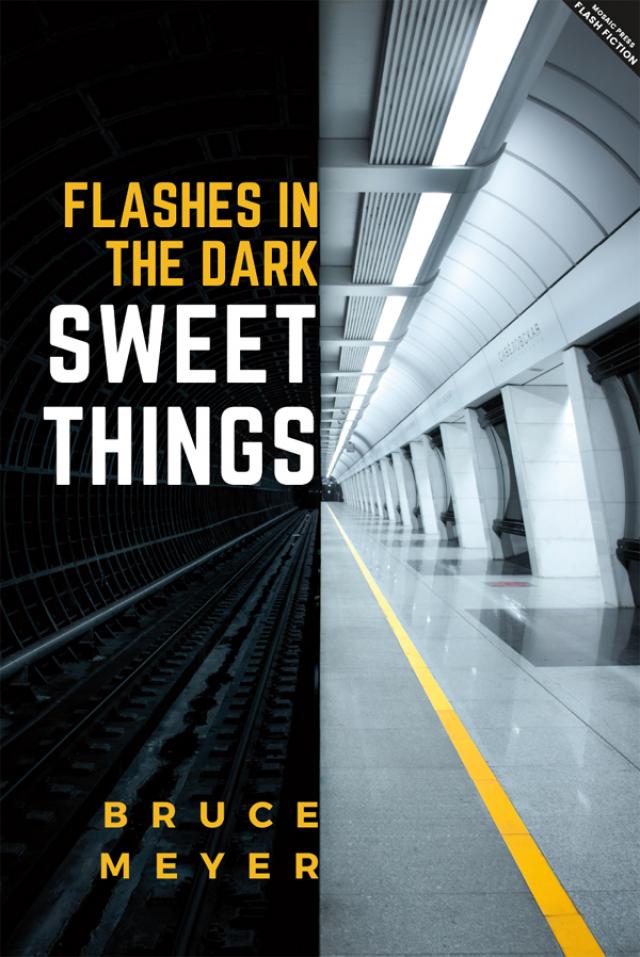
Sweet Things
Sweet Things
Flashes in the Dark
Bruce Meyer
Library and Archives Canada Cataloguing in Publication
Title: Sweet things : flashes in the dark / Bruce Meyer.
Names: Meyer, Bruce, 1957- author.
Description: Short stories.
Identifiers:
Canadiana (print) 2022024300X
Canadiana (ebook) 20220243026
ISBN 9781771616560 (softcover) ISBN 9781771616577 (PDF)
ISBN 9781771616584 (EPUB) ISBN 9781771616591 (Kindle)
Classification:
LCC PS8576.E93 S94 2022
DDC C813/.54—dc23
Published by Mosaic Press, Oakville, Ontario, Canada, 2020.
MOSAIC PRESS, Publishers
www.Mosaic-Press.com
Copyright © Bruce Meyer, 2022
All rights reserved. Without limiting the rights under copyright reserved here, no part of this publication may be reproduced, stored in or introduced into any retrieval system, or transmitted in any form or by any means—electronic, mechanical, by photocopy, recording or otherwise—without the prior written permission and consent of both the copyright owners and the Publisher
Printed and bound in Canada.
MOSAIC PRESS
1252 Speers Road, Units 1 & 2, Oakville, Ontario, L6L 5N9
(905) 825-2130 • info@mosaic-press.com • www.mosaic-press.com
Contents
Wheel
The Langlois Bridge (longlisted Strand International Fiction Contest)
Cuba (Retreat West Fiction Prize)
The Riverside
The Paulsens
Vikings
Nessun Dorma
The Other Side of the World
Guide
Portrait
Rare Flower (Fiction North)
Princess and Rick
How to Draw a Frog (Editors’ Prize, Edinburgh Flash Fiction Prize)
Every Day
Afternoon (Heartwood Literary Magazine)
The Toll [renamed The Shadow]
Day of the Dead
Eleanor
A Short Film About Seagulls (shortlisted Fish Flash Fiction Prize)
Worldly Goods (The Song Between Our Stars)
The Brothers
Toothbrush (Hash Journal)
Auntie
Rust
The Trailer (London Independent Short Story Prize finalist)
Arums (Lothlarien Review)
Sweet Things
Aces
The Boiling Point (A Chronicle of Magpies)
The Old Man (Fictive Dream)
Happy (Finding the Birds)
The Beach
Breed (Nunum)
Harpy
Finlandia
Archivist (shortlisted Strand International FF contest)
St. John’s Dance
The Tapestry
Chupacabra
Sleep Walking
Sentry
It’s a Girl!
Roar
The Laurel
Silences
Suntrap
Gran’s Hats (Unlimited Literature)
Cornfield
The Cloud (Flash Frontier)
Flight (London Independent Short Story Prize finalist)
Same Time Next Year
Rats with Wings
The Little Dog Laughed
The Lesson Plan
Wallpaper
Settling Up
Pigs Can Fly
Worth Keeping
Swimmer (Emerge Literary Journal)
Sorrow (Panoplyzine)
Calaveras
Winter (Uproar)
Birth (Crepe and Pen)
A Light Eulogy
Wax (Strands International, India)
Grains of Sand
Ventriloquism
Everard (Grattan Street Press Anthology)
Hyla Smiles
Literary Awards
About the Author
Acknowledgments
Not knowing is the sweetest life.
Sophocles
In order for the light to shine so brightly the darkness must be present.
Francis Bacon
Wheel
I am no longer afraid of heights. When I was young, the idea of riding skyward on a Ferris wheel terrified me. My grandmother kept coaxing me to ride with her. She loved roller coasters, too.
“When we get up to the top we can see everything,” she said.
Eventually, when I was ten I relented and went on the wheel with her. As we waited at the top for the lower buckets to load, she began to rock our seat back and forth. I wanted to be sick.
By the next summer, she was dying. We watched The Ed Sullivan Show on a tv in the ward lounge. Pearl Bailey was singing, “That’s Life,” about being shot down in April and back on top in June. My grandmother shouted out, “Oh sing it, Pearl!” I’d never heard her that enthusiastic about a song.
After she died, I struggled to keep up with my studies. I suffered a very dark period. My attempts at finding work were a disaster. I began a position in a bookstore, but my cash float was off by ten cents one day. I must have miscounted someone’s change. I was accused of stealing and released at the end of the day.
I managed to get to graduate school on the inheritance from my grandmother and studied Medieval literature, not just Chaucer, but his contemporaries – Hoccleve and Gower – and determined to immerse myself in their world.
I took a train one summer morning from London to Rochester in Kent. London was snarled with a state funeral. The only person in Rochester Cathedral was an elderly woman mopping the nave. I asked if the church was open.
At first, she said “No,” then looking me up and down decided I was not the sort who might do damage to the place. I had a camera around my neck and a notebook in my hand.
“Stay as long as you wish,” she said, “just close the door behind you when you leave.” She said she was off to see the funeral and disappeared through a small door on the south aisle. A moment later, she returned and handed me an annotated floor plan.
There is no feeling like having a gothic cathedral all to oneself. Sound, light, air soar upwards. The alabaster tomb of a Medieval bishop glowed in a column of light. His praying hands lit up like angels. In the silent enormity of the church, I wanted to say the word “Amen,” but refrained for fear I would break the spell of the sanctuary. Birds were arguing in the eaves. The rest was stillness.
I ascended the steps of the chancel and stood looking the length of the rows, each seat shoulder to shoulder with the next in a congregation of ghosts. I was about to turn away and walk down into the nave when I saw a patch of column that wasn’t whitewashed on one of the pillars facing me.
Beneath the layers of Puritan erasure was a Medieval wall painting. A queen was standing beside a Ferris wheel. I studied her face. She bore an uncanny resemblance to my grandmother, or perhaps I just wanted to see her likeness there because I promised her that someday I would ride a Ferris wheel with her and not be afraid.
In ascending buckets of the wheel, kings were donning their crowns. On the descending side, monarchs were tumbling from their seats, their diadems falling from their heads as they fought to grasp at an illusion. I sat down on the chancel steps and read the guide sheet. The painting depicted a passage from Boethius’ Consolation of Philosophy. As it faced the altar, it was meant to instill in the priests, even at the moment of their greatest power, the humility that says all success and worldly worth are but rumors. I wanted to shout out, “Oh sing it Pearl!” because at last, I understood the life my grandmother had led. Two wars, the Great Depression, the years of scraping by, days and nights of hardship – all they had given her was the right to let go and fling her arms in the air as the coaster cars roared downward.
A bookstore near the station had reopened after the funeral and I found a copy of Boethius. In his despair, as he languished in a Roman prison, he argued that all fortune is an illusion. One day can be good, the next awful. I thought about my grandmother asking me to join her on the wheel if only so we could reach the top and she could rock the bucket until I was not afraid. And had I relented and risen with her as far as we could go, the view would have been stunning.
The Langlois Bridge
(Longlisted Strand International Fiction Contest)
I am seated beside a blond woman on the bank of the Bouc Canal outside Arles, the town Van Gogh painted at the height of his career. The narrow lift bridge destroyed by the retreating Germans in 1944 is still intact. The colors in the dream are more vivid than if I was inside a rainbow. I recall holding the woman in my arms when we woke that morning.
What frightens me is the feeling I get as we pass a bottle of wine back and forth and talk about Vincent’s letters, the passion he exuded as he struggled to see this world from the vantage of another. He wasn’t mad. He was simply somewhere else and watching our madness from far away. What frightens me is that I don’t know who you are. Are you someone I knew in another life? Is the painting merely the depiction of a bridge or is it a mask:
There are likely more realms of existence – more things in Heaven and Earth than are dreamt of in my philosophy – that we cannot see or know. The beauty of the moment is real to me. You are real to me, and what frightens me is that I lost you. Happiness, success, wealth, joy, love are all contingent on where one wakes and all are illusions, veils life puts on the keep us from seeing the details of even our own lives.