Kate hardy, p.1
Kate Hardy, page 1


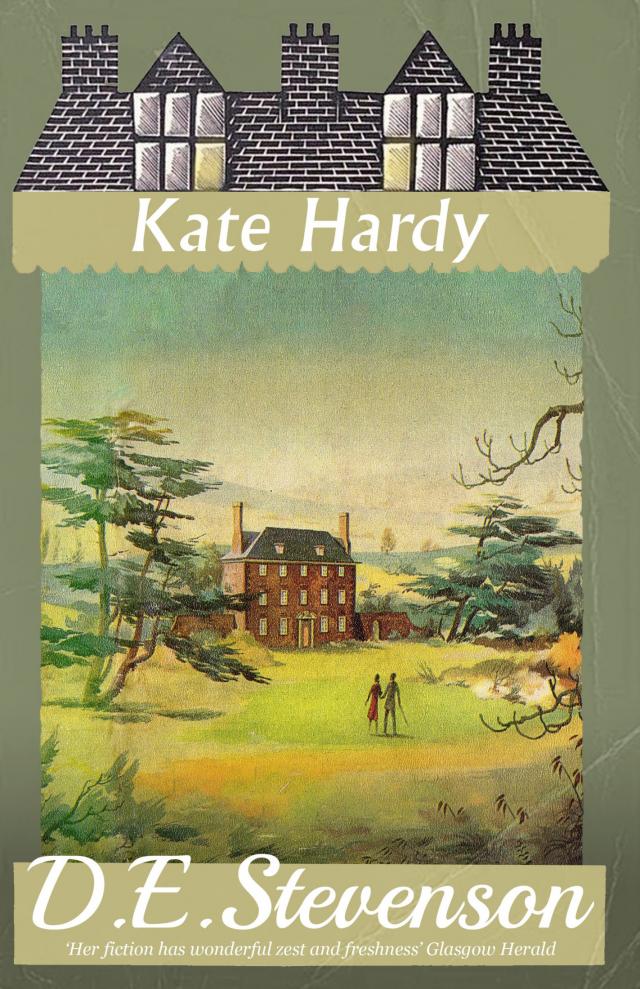
D.E. Stevenson
Kate Hardy
“Do you know anything about her, Richard?”
“Nothing except that she lives in London, is obviously well off and very impulsive. . . . She bought the house as if it were—a bun. She bought it straight off without seeing it.”
“She must be mad!”
The arrival of novelist Kate Hardy at the lovely Dower House in Old Quinings, with her staunch ally and housekeeper Martha, has the whole village talking. But Kate is not in fact mad, merely in need of escape from her selfish sister Milly and spoiled niece Minty. Though welcomed warmly by Richard Morven at the Manor House and the charming, widowed Mrs. Stark, Kate likewise finds herself taken for a witch and is then one of the targets of a poison pen campaign—not to mention the rumours that her new home is haunted by its past inhabitant. With the arrival of Mrs. Stark’s son Walter, back from his wartime triumphs and finding readjustment to village life difficult, Kate may find that the country allows her as little time for writing as London!
First published in 1947 and providing a fascinating glimpse of English life in the immediate postwar years, Kate Hardy is an irresistible tale of village life, challenging family relations, romance, and D.E. Stevenson’s incomparable storytelling. Also included in this edition is an autobiographical sketch by the author.
“Miss Stevenson has her own individual and charming way of seeing things.” Western Mail
FM76
“Worth makes the man, and want of it the fellow;
The rest is all but leather or prunella.”
POPE.
Contents
Cover
Title Page/About the Book
Epigraph
Contents
Part One
Chapter One
Chapter Two
Chapter Three
Chapter Four
Chapter Five
Chapter Six
Chapter Seven
Chapter Eight
Chapter Nine
Chapter Ten
Part Two
Chapter Eleven
Chapter Twelve
Chapter Thirteen
Chapter Fourteen
Chapter Fifteen
Chapter Sixteen
Chapter Seventeen
Chapter Eighteen
Chapter Nineteen
Chapter Twenty
Part Three
Chapter Twenty-One
Chapter Twenty-Two
Chapter Twenty-Three
Chapter Twenty-Four
Chapter Twenty-Five
An Autobiographical Sketch
About the Author
Titles by D.E. Stevenson
Furrowed Middlebrow Titles
Copyright
Part One
CHAPTER I
The village of Old Quinings started its existence as a huddle of cottages attached to a Priory which was famed throughout the district for its orchard; and it was a moot point whether the village had derived its name from a particularly succulent species of pear or the pear had been named after the village. The Priory was now a ruin in the grounds of the Morven estate, but the orchard was still flourishing and still produced apples and pears in profusion. There was a parable here—or so the Vicar thought—for the strong thick walls of the Priory had fallen and were crumbling to dust, whereas the trees were alive and beautiful. They were not actually the same trees, of course, but descendants of those which the monks had planted. The stone thing had perished and the living thing was still alive—time had failed to destroy it.
Time had failed to destroy the orchard; it had grown and flourished, so also had the Morven family, which had come to Old Quinings and settled here when the monks were dispossessed of their lands by Henry VIII. The present Richard Morven was directly descended from the first Richard Morven; between the two Richards, linking them together, was an unbroken chain of Richards and Henrys whose portraits hung upon the walls of the Manor and whose bones lay in the family vault. The present Manor House was built in the reign of Queen Anne (replacing an older structure which had been destroyed by fire); it was of red brick, mellowed to a soft pink, delightful to behold. It stood upon a slight rise surrounded by fine old trees, and was approached by avenues from the south and west.
The village was charming. It had grown extensively during the early years of the eighteenth century (the inn and coaching establishment at one end of the village street, the church, the hall and several very pleasant family residences in the neighbourhood all dated from that period and, like the Manor, were of red brick); after that period Old Quinings grew very slowly and presently stopped growing altogether, for there were no factories to bring people to the place: it was too far from London for business men to live and the railway service was deplorable.
Old Quinings did not mind being left behind in the march of progress; it was quite pleased with itself. If people wanted factories and cinemas and a good railway service they could go elsewhere; if they liked peace and quiet they could live at Old Quinings. It was just the right size—so its inhabitants thought—for it was large enough to provide all the amenities of civilised life and small enough to be a complete whole. Every one knew every one else and every one else’s business.
The rumour that Mr. Morven had sold the Dower House was every one’s business. There was not a creature in Old Quinings who was not interested in the news. Nobody had any idea how the rumour originated, but there it was, flying from house to house like a raging fire. The villagers heard it first, of course, but by nine o’clock the rumour had reached most of the bigger houses and was being discussed and commented upon at the breakfast table. Most people were pleased, for the Dower House had stood empty for nearly a year—ever since old Miss Morven died—and it would be pleasant to see the house occupied again, especially if the newcomers were “nice”; but some of the older people were not so pleased. It seemed wrong that Mr. Morven should sell the Dower House, which was part of the estate. He should have leased it—perhaps he had leased it—after all, the whole thing was only a rumour and as such to be accepted with a grain of salt.
It was a windy March morning. Mr. Morven came out of his south gate, which opened straight onto the village street, and set off through the village at a brisk pace. As usual he had two dogs at his heels, two brown cockers with curly coats, who followed him like two brown shadows. Quite a number of people, who were shopping or talking or hurrying home with full baskets, saw Mr. Morven and greeted him; some of them commented on the weather—a peck of March dust is worth a king’s ransom—but although every one was burning to ask whether or not the rumour was true and if so who had bought Dower House and when they were coming and a dozen other questions, nobody had the temerity to do so. This was all the more curious because Richard Morven was a friendly person and his neighbours liked him. They were proud of him, too, for he was a “proper squire.” He looked a squire, tall and well-made with greying hair and fine eyes, and he behaved as a squire should, which is to say he was always polite and pleasant and well-mannered in a slightly old-fashioned way. Perhaps it was this slightly old-fashioned way of his which protected him from the curiosity of his neighbours.
Miss Crease was different, of course; for one thing she was old and ugly, and for another she had known Richard Morven since the day he was born. She was in her garden when she saw him walking down the street and she called and beckoned to him in a peremptory manner.
Richard Morven stopped at once, crossed the street and leant upon the gate; the spaniels sat down one on either side and waited patiently.
“You’ve sold Dower House, they say,” said Miss Crease, hobbling across the grass. “I hope you’ve got a good thumping price for it. Who have you sold it to and when are they coming? Are they going to do it up or what?”
“Bush telegraph,” said Richard Morven, smiling. He had a very charming smile which crinkled up the corners of his eyes.
“Bush telegraph or grape-vine or something,” agreed Miss Crease. “It’s quite odd, isn’t it? They know more about you than you know yourself.”
“Quite odd . . . so that was why! I had a curious feeling as I came through the village, as if . . . as if . . .”
“I know,” nodded Miss Crease. “And of course they were all talking about you and trying to make up their minds to tackle you about it—but nobody dared, except me.” She gave a little cackle of amusement at her own temerity.
“How did they know!” said Richard thoughtfully. “How could they know?”
“So it’s true?”
“Perfectly true. I sold it yesterday through my lawyers in London. The purchaser is a lady.”
“Is she pretty?” demanded Miss Crease.
Richard Morven was taken aback. The question seemed an extraordinary one coming from Miss Crease. He had expected questions, of course, for Miss Crease was of an inquisitive nature, but not this question. She was so incredibly ugly herself, and always had been . . . but perhaps that was why, thought Richard vaguely.
“Is she pretty?” repeated Miss Crease.
“Does it matter?” asked Richard.
“Of course it matters. Dr. Johnson said beauty in itself is estimable and should be respected—or words to that effect. I ask you for the third time, is she pretty?”
Richard smiled. “I don’t know,” he said. “Lawyers don’t tell you things like that. They’re more interested in the colour of the lady’s money than the colour of her hair.”
“Pshaw!” exclaimed Miss Crease in disgust.
“Quite,” said R ichard gravely. “I agree with you. It would be interesting to know whether or not my new neighbour is pleasant to look at.”
“Interesting!” cried Miss Crease with an upward inflexion. “It’s essential. Don’t you know anything about her, Richard?”
“Nothing except that she lives in London, is obviously well off and very impulsive.”
“Impulsive?” cried Miss Crease, seizing upon the word.
“She bought the house as if it were—a bun. She bought it straight off without seeing it.”
“She must be mad!” cried Miss Crease incredulously.
“Houses are scarce,” he reminded her.
There was a short silence.
“Richard,” said Miss Crease at last in quite a different tone. “Richard, were you wise? She may be a horrible person. She may be young and entertain hordes of ‘bright young things’ who will rush madly about the village in noisy cars. She may be old and disagreeable. The Dower House is next door to me; it is actually in your grounds. Oh, I know it has a high wall all round and a separate entrance, but still . . .” She paused and looked at him.
“Yes,” he agreed. “Yes, I know. I didn’t mean to sell it like that to somebody I knew nothing about. I thought people would come down and see it—and all that. But once I had told Dickson and Weller to sell the place it was out of my hands. They sold it. I suppose I couldn’t really complain.”
“Did you complain?”
“I hadn’t the face,” admitted Richard with a deprecating smile.
“Oh, well, perhaps it will get you out of your rut.”
“But I like my rut! I was thankful to get back into my nice comfortable rut as soon as the war was over. My rut fits me perfectly. Nothing shall dig me out.”
“I like mine, too, but there’s an excuse for me. I’m old,” said Miss Crease.
“I’m getting old,” smiled Richard.
“You’re forty-five,” said Miss Crease firmly. “You’re a mere child. It seems only yesterday you came to see me with your mother and ate sugar biscuits. Do you ever hear from your wife?”
“Occasionally,” said Richard Morven, closing up like an oyster.
Miss Crease was old and ugly and therefore licensed to be inquisitive and to rush in where angels feared to tread, but she knew that this time she had gone too far. But anyhow I got something out of him, thought Miss Crease as she watched him walk away.
Continuing his walk, Richard thought over the conversation. He had been uneasy before and his old friend’s trenchant remarks had increased his discomfort. Perhaps he had been foolish . . . but he had never dreamt that the house would be sold straight off like that in a matter of hours without any of the usual preliminaries. It would be most annoying if the new owner disturbed the even tenor of life at Old Quinings. Richard Morven was wedded to peace and quiet, he had his books, his garden and his dogs—he wanted no more. Mr. and Mrs. Haygarth, an invaluable couple, looked after him and made him extremely comfortable. Richard had spent the war in an administrative post, he had been swept into it willy-nilly at the beginning, but although he had to live in Bath to be near his work he was able to get home for week-ends. The Haygarths were over-age for war service so they had kept the Manor open. It had worked out well.
Richard strode on. He had taken the path which led across the moor, and the breeze and the sunshine began to raise his spirits. The thing was done—and why imagine unpleasant consequences? It was natural to suppose that only a woman who liked a quiet country life would buy a house in a quiet country village. Very well then, why worry? Miss Crease was old and crotchety . . . she was getting positively childish, thought Richard. It was unpardonable of her to mention Wanda . . . like that . . . quite suddenly . . . quite irrelevantly. Richard preferred not to think about his wife. He had discovered that if one really made up one’s mind firmly enough one could stop thinking about a subject which gave one pain. He had done so years ago—it was galling to find that other people still thought about Wanda, discussed her.
Richard decapitated a thistle with his stick. He was upset and Miss Crease’s inconsiderate remark had brought Wanda clearly to his mind. He could not dismiss her image. . . . Very well, he would think of her deliberately.
Although it was now more than fourteen years ago Richard remembered every detail of the evening he had first seen Wanda. It was at the Savoy. He was asked to join a party for supper after the theatre and Wanda was one of the party. She was absolutely beautiful, breathtakingly beautiful; Richard had never seen anything or anybody so beautiful before—no wonder he had fallen in love with her. Wanda had been swept off her feet by Richard’s adoration and in a few months they were married. At first they were happy together but not for long; Richard soon began to realise that the quiet life at Old Quinings was boring Wanda; she was half American and used to her own way; she was used to gaiety and admiration. The fact was, thought Richard as he strode along, he and Wanda were not really companions. Wanda was so lovely to look at that he had credited her with a depth of soul she did not possess . . . he did not know what Wanda had thought about him but he was aware that he had not come up to her expectations as a husband. She found Old Quinings dull—that was the real trouble. When once she had redecorated the Manor and installed the ultra-modern plumbing she considered essential, there was nothing left for her to do, no outlet for her abounding vitality. Wanda liked travelling, Richard preferred to stay at home, so they drifted into the habit of doing as they pleased without reference to each other. This was all the easier because Wanda had money of her own and therefore was completely independent. There was no definite break (as far as Richard could remember, the matter had not even been discussed between them), there was no unpleasantness at all. They just drifted into the arrangement. Wanda had hosts of friends who continually asked her to go with them to Cannes, or Egypt or Scotland; at first Richard was asked too, but as he always refused and Wanda accepted rapturously it became natural to leave him out of the invitation. Old Quinings remained Wanda’s home; she returned when she wanted a peaceful interlude and lived with Richard quite happily. In fact she made it clear that she liked her home and her husband quite a lot as long as she was free to leave them when the spirit moved her.
Their daughter was born in 1937; they called her Susan after Richard’s mother. Wanda had not intended to have a child but she behaved quite well about it, and she was so strong and healthy that she was soon as fit as ever and if possible more beautiful than before. She engaged a competent nurse for Susan and went off to Egypt for the winter. Munich put a stop to Wanda’s activities; she decided that Europe was too unsettled to be comfortable and turned her eyes west. She had countless relatives in America, all clamouring for her to come and bring Susan with her—Susan’s maternal grandmother had never seen the child. Richard saw no reason why they should not go; he did not intend to leave his home, of course, but he and Wanda were used to separation. Wanda considered the matter for a few days and then packed up and departed, taking Susan and the nurse as part of her mountainous baggage. Richard had seen them off at Tilbury and he had not seen them since.
He had heard from Wanda quite frequently at first; when the war started she wrote urging him to come. Britain was finished, wrote Wanda, every one in the States was certain of that. Richard disagreed with these views, and in any case he felt that if Britain was done for he would rather go down with Britain than watch her downfall from a foreign shore. He wrote and told Wanda what he felt and stayed at home. Several other letters passed between them, letters tinged with bitterness, for they could not understand one another’s point of view. This was the first real disagreement between them, it was the first time they had found a subject important enough to rouse their passions.
The bitterness passed, of course (it passed when the United States entered the war), but the fact that they had disagreed so profoundly left an unpleasant feeling behind. Lately Richard had heard from Wanda again; her letters were colourless, they did not express her personality; she told him very little of interest about herself and her affairs.