Best british short stori.., p.1
Best British Short Stories 2023, page 1
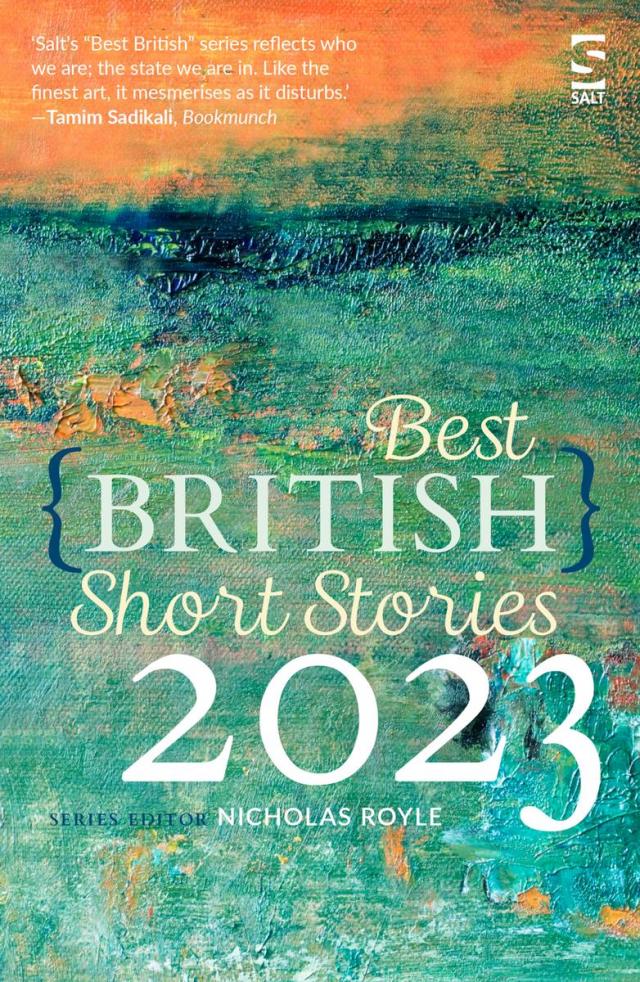


CONTENTS
Title Page
Dedication
NICHOLAS ROYLE
Introduction
MILES GREENWOOD
Islands
LYDIA GILL
The Lowing
DAVID WHELDON
The Statistics Rebellion
SHARON KIVLAND
The Incorruptible
DJ TAYLOR
Somewhere Out There West of Thetford
BRIONY THOMPSON
The Nights
PHILIP JENNINGS
Elephant
KERRY HADLEY-PRYCE
Chimera
JOHN SAUL
The Clearance
JIM GIBSON
The Thinker
GEORGINA PARFITT
Middle Ground
MATTHEW TURNER
Still Life
LEONE ROSS
When We Went Gallivanting
MARK VALENTINE
Qx
ALINAH AZADEH
The Beard
GARETH E REES
The Slime Factory
AK BLAKEMORE
Bonsoir (after Ithell Colquhoun)
ALISON MOORE
Common Ground
DAVID BEVAN
The Bull
GABRIEL FLYNN
Tinhead
Contributor Biographies
Acknowledgments
About this Book
About the Author
By the Same Author
Copyright
To the memory of David Wheldon (1950–2021)
NICHOLAS ROYLE
Introduction
TAKING THE FORM OF A HIGHLY SUBJECTIVE ALPHABET OF THE SHORT STORY
A is for anthologies, as distinct from collections. Most people seem happy to go along with the convention that a multi-author volume is known as an anthology, leaving ‘collection’ to describe a book of stories by a single author. Anthologies are how many readers come across short stories and, indeed, new short story writers. Anthologies may be themed or unthemed, consist of all new stories, or a mixture of original pieces and reprints, or be all reprints. Some editors, or series, combine different forms – stories with poetry and essays, for example – but if you love stories you might feel that amounts to taking up space that could have been given to more stories. Some great anthologies: Alberto Manguel’s Black Water: The Anthology of Fantastic Literature, Ramsey Campbell’s New Terrors 1 (and 2, for that matter), Daniel Halpern’s The Art of the Tale: An International Anthology of Short Stories 1945–1985, The Slow Mirror and Other Stories: New Fiction by Jewish Writers edited by Sonja Lyndon and Sylvia Paskin, John Burke’s Tales of Unease, Chick-Lit: Postfeminist Fiction edited by Cris Mazza and Jeffrey DeShell, Kirby McCauley’s Dark Forces, P.E.N. New Fiction I edited by Peter Ackroyd (and follow-up volume II edited by Allan Massie – what a shame there were no more), Giles Gordon’s Beyond the Words: Eleven Writers in Search of a New Fiction and a million others.
B is for JG Ballard, but it could have been for Iain Banks, AL Barker, Clive Barker, Djuna Barnes, Stan Barstow, Alan Beard, John Berger, Jorge Luis Borges, Pierre Bourgeade, Elizabeth Bowen, Ray Bradbury, Richard Brautigan, Christopher Burns, Ron Butlin or Dino Buzatti.
C is for chapbooks. Given that the short story is the best literary form (see F is for form), we need a way to publish individual stories with their own covers, cover art and International Standard Book Numbers (ISBNs). Fortunately we have one. It’s called the chapbook. Not all chapbooks have ISBNs, but if publishers go to the trouble and expense of acquiring them, they are then required to supply copies to the copyright libraries, and the libraries are obliged to add them to their collections. That’s nice for authors and readers, as chapbooks are often limited editions and, so, when they’re gone, they’re gone. But, when they’re gone, they’re still available to read at the British Library and other copyright libraries. Chapbooks publishers are often shoestring operations, looking on wistfully as publishers of poetry pamphlets rake in Michael Marks Awards For Poetry Pamphlets worth £5000. There’s no equivalent award for publishers of fiction chapbooks, which could be seen, looking at it in a glass-half-full sort of way, as a gap in the market for philanthropists.
D is for Elspeth Davie, but it could have been for Roald Dahl, Marie Darrieussecq, EL Doctorow, Andre Dubus or Patricia Duncker.
E is for experimental fiction. (See O is for Oulipo.) The short story is the perfect form (see F is for form) for experimental writing. Short stories are by no means easier to write than novels – indeed they may be harder to write and get right – but there’s less at stake, for both writer and reader. If you’re the writer, it might take you a morning, or a week or a month, to get a story right, rather than the six or twelve months or more that the novel might require. So, if you want to gamble, if you want to take a risk, there’s a less at stake. If you’re the reader, what are we talking about? Ten minutes, twenty, half an hour? You, the reader, can also afford to take a risk. If it doesn’t work for you, what have you lost? Half an hour at the most. Have you got ten minutes or twenty minutes or half an hour for BS Johnson or Imogen Reid or Simon Okotie or Joanna Walsh or Will Eaves or Paul Griffiths or Robert Coover or Rikki Ducornet or Tony White or Giles Gordon or David Rose or Susan Daitch (see X is for ‘X ≠ Y’)?
F is for form. Form is how we distinguish between fiction, drama, poetry and non-fiction, and other forms, and how we further distinguish between novel, novella, short story and so on. I’m deliberately not including ‘flash fiction’, because it’s such an awful term, which has somehow taken hold and spread, like dry rot. To be clear, I’m talking about the term, not the work published under that umbrella, but the very nature of the term, with its implications of speed and ephemerality, is, I think, unhelpful. Might it not encourage writers to dash off pieces of so-called flash fiction rather than work at them patiently? David Gaffney, who has published several excellent collections of very short stories, doesn’t dash them off. He writes longer stories and then chips and chisels away at them until they are 150 words long, or whatever. I don’t really know why we need a special term to describe stories that are shorter than average, but if we do, what’s wrong with short short stories, or very short stories, or micro fiction? Anything, frankly, rather than flash fiction. I do recognise that I have a bee in my bonnet about this.
G is for Giles Gordon. Gordon (1940–2003) was mentioned twice in the New Statesman – in a diary piece and subsequently on the letters page – while I was writing this piece. On each occasion he was described as ‘agent Giles Gordon’. It’s true that he was a literary agent and a very good one, with happy clients, but it would be a great shame if we lost sight of the fact that he was also an accomplished and entertaining novelist and short story writer (he also wrote poetry and a memoir) and anthologist. In his short stories – and in his novels, for that matter – he often experimented (see E is for experimental fiction) with style and form, and as an editor he supported writers of experimental fiction (see A is for anthologies). With David Hughes he edited ten volumes of Best Short Stories between 1986 and 1995. One of his own stories, ‘Couple’, was published as a chapbook (see C is for chapbooks) by Sceptre Press of Knotting, Bedford.
H is for horror. Ghost stories are perennially popular. Is it their brevity that appeals? Maybe, partly, but what about big horror novels, Peter Straub’s 500-page Ghost Story, for example? They have their legions of fans, too. Is it that Jamesian (MR, not Henry) idea of sitting around an open fire and being told a story? Is it a mixture of that and the same reason why experimental fiction and the short story are such a good fit (see E is for Experimental fiction)? Horror is an emotion, an uncomfortable, sometimes extreme one. To evoke it in the reader is to take a risk. Alison Moore’s ‘Small Animals’ is only ten pages long, but it’s so intense and your nerves are jangling so much, you wouldn’t want it to be even a page longer. Robert Aickman’s ‘strange stories’ do tend to be longer: twenty pages, thirty, or more. A sinister atmosphere develops, a sense of doom pervades. Will it work, you might ask, in the back of your mind, will he pull it off? The answer is always yes.
I is for idea. Which is how most of those stories we are told around the fire (see H is for horror) actually begin – with an idea, a ‘what if’.
J is for the Jacksons. You’ll know Shirley Jackson, author of ‘The Lottery’ and many other dark stories, but you might not be familiar with her near namesake Shelley Jackson, author of the 2002 short story collection The Melancholy of Anatomy and of the story ‘Skin’, published on the bodies of 2095 volunteers, or ‘Words’, each of whom has had one word from the story tattooed in a specific location of their own choosing. I’m lucky enough to be one of them. My word is ‘After’.
K is for Jamaica Kincaid, but it could have been for Franz Kafka, Anna Kavan, James Kelman, Heinrich von Kleist or Hanif Kureishi.
L is for Clarice Lispector. Her short story, ‘The Imitation of the Rose’, reprinted in Other Fires: Stories From the Women of Latin America edited by Alberto Manguel (see M is for Alberto Manguel), is an account of mental illness as powerful, in its own subtle way, as Charlotte Perkins Gilman’s ‘The Yellow Wallpaper’ (see U is for Errol Undercliffe).
M is for Alberto Manguel. They say you shouldn’t meet your heroes – actually, don’t they also say you shouldn’t even have heroes? – but I met Manguel, the editor of Black Water: The Anthology of Fantastic Literature and White Fire: Further Fantastic Literature, and he
N is for Gary Numan. I remember reading, as a 16-year-old, probably in Smash Hits or the NME, about Numan’s dabbling in literature. The Tubeway Army frontman, who captured the imagination of fans with his lyrics about electric ‘friends’ and ‘Machmen’, had written science fiction stories before he started recording music. I wanted to read those stories. I still do.
O is for Oulipo. (See E is for experimental fiction.) Oulipo – short for Ouvroir de littérature potentielle, which translates as Workshop For Potential Literature – was formed in France in 1960 by writer Raymond Queneau and mathematician François Le Lionnais. They encouraged the practice of writing under specific constraints. Many writers have enthusiastically taken up the baton, some of whom are featured in The Penguin Book of Oulipo edited by Philip Terry.
P is for Penguin Modern Stories. This quarterly anthology series edited by Judith Burnley ran from 1969 to 1972, featuring three to five writers in each volume, with between one and three stories from each writer. It finished after twelve volumes. Stories were appearing for the first time in the UK and were by a mixture of established writers and new names. Design was by David Pelham, using bold, solid colours, a different one for each book, with the number appearing in large, white type on both front and back covers. You see them now and again in charity shops and second-hand bookshops. If you’re lucky you might spot a multicoloured box set including volumes one to six. The series kicked off with William Sansom (see S is for William Sansom) joined by Jean Rhys, David Plante and Bernard Malamud. Other notable writers who appeared as the series proceeded included Sylvia Plath, Margaret Drabble, Giles Gordon (see G is for Giles Gordon), Elizabeth Taylor, BS Johnson, William Trevor, Jennifer Dawson and Gabriel Josipovici. If you do see one – a box set or a single volume – they’re well worth picking up.
Q is for questions. I like to be left with more of them than answers. The short story is perfect for that.
R is for Alain Robbe-Grillet, whose status as a short story writer is out of proportion to the number of stories he actually published. The slim volume Instantanés published by Editions de Minuit in 1962, and issued in translation as Snapshots, contained six stories, two of which, ‘La plage’ (‘The Beach’) and ‘Dans les couloirs du métropolitain’ (‘In the Corridors of the Métro’), have been reprinted in various places. Both stories exemplify a tendency towards repetition of image and narrative within a story that is characteristic of the nouveau roman (new novel), of which Robbe-Grillet was a key exponent. The unfurling of waves on a beach and the constant motion of an escalator create infinite loops within which we see actions appear to repeat themselves, with uncanny effects.
S is for William Sansom, but it could have been for Saki, James Salter, Greg Sanders, Bruno Schulz, Ellis Sharp, Alan Sillitoe, Clive Sinclair, Muriel Spark or Robert Stone.
T is for tense, which is what I become when I think about a certain highly regarded writer, who wrote – more than a decade ago now, but I can’t get it out of my head – of his displeasure at how often the present tense was being used in the contemporary English novel. I took his first short story collection down from the shelf, curious to see if it included any stories in the present tense. It does: two. The use of the present tense in those two stories does not especially distinguish them from the other stories in the collection. The present tense is there for writers to use, whether in the novel or in the short story. Use it well and readers will be happy.
U is for Errol Undercliffe. Horror (see H is for horror) maestro Ramsey Campbell’s 1973 collection Demons By Daylight was, interestingly, divided into three parts: ‘Nightmares’ opened the collection and ‘Relationships’ closed it. Caught between the two was the curious and fascinating ‘Errol Undercliffe: a tribute’, which comprised a short biographical note about Undercliffe, ‘a Brichester writer whose work has only recently begun to reach a wider public’, a first-person piece narrated by ‘Campbell’ entitled ‘The Franklyn Paragraphs’ that reads, at least to begin with, like a memoir, and a short story, ‘The Interloper’, by Undercliffe. I put ‘Campbell’ in inverted commas, because ‘The Franklyn Paragraphs’ is Campbell’s fiction, as is ‘The Interloper’, of course, since both Undercliffe and Brichester are his invention. In ‘The Franklyn Paragraphs’, the narrator visits Undercliffe’s flat after the disappearance of the Brichester writer: ‘The wallpaper had a Charlotte Perkins Gilman look; once Undercliffe complained that “such an absurd story should have used up an inspiration which I could work into one of my best tales.”’ (See L is for Clarice Lispector.) Campbell’s opinion of Charlotte Perkins Gilman’s ‘The Yellow Wallpaper’ is higher than Undercliffe’s: he included it in The Folio Book of Horror Stories, which he edited for the Folio Society in 2018.
V is for Boris Vian. Another author with a pseudonym (Ramsey Campbell also published a novel as Jay Ramsay), Boris Vian was a novelist, short story writer, poet, musician, singer and critic, who published some of his work, a string of controversial crime novels, under the name Vernon Sullivan. Of Vian’s four short story collections, two were published posthumously (he died young, at 39). Le loup-garou (The Werewolf), the second of these, kicks off with ‘Le loup-garou’, in which a wolf turns into a man, but only on the full moon, a clever inversion of the myth. ‘Martin m’a téléphoné’ is a jazz story, about picking up gigs in clubs. ‘Les chiens, le désir et la mort’ was originally published under the Sullivan pseudonym and is one of the strongest stories in the collection, a fatalistic noir piece about a taxi driver who picks up a fare he probably should have left waiting on the sidewalk.
W is for Paul Willems. Belgian novelist, playwright and short story writer Paul Willems (1912–97) published two collections towards the end of his life. La cathédrale de brume was the first of these and is available in English translation, as The Cathedral of Mist, from US-based Wakefield Press. Willems came from near Antwerp, but wrote in French. ‘Requiem pour le pain’ begins with the narrator’s cousin explaining to him that the reason his grandmother told him to break bread with his hands rather than cut it with a knife was because the moment a knife touches bread, the bread cries out. Moments later, the cousin falls out of a window to her death and the narrator’s grandmother reassures him that his cousin will be in paradise, more precisely in a pension in Ostend for dead little girls. Ballard (see B is for JG Ballard) was a fan of the Belgian artist Paul Delvaux. Maybe he also knew of Willems’ work. Ostend, the narrator of Willems’ story tells us, is submerged by the sea during the night. Only in the morning do the waves recede. This reminds us of the opening of Ballard’s story ‘Now Wakes the Sea’: ‘Again at night Mason heard the sounds of the approaching sea, the muffled thunder of breakers rolling up the near-by streets.’ Another of Willems’ stories, ‘Tchiripisch’, is set in Bulgaria, but the narrator of that story remembers a dream he had in Ostend. He could hear waves breaking on the beach (see Z is for Curtis Zahn) and it seemed to him that they uttered two words, one as they broke and another as they withdrew, taking back the first word. What the words were was not, in the end, revealed to him.
X is for ‘X ≠ Y’. This story, by the American novelist and short story writer Susan Daitch, was published in Bomb magazine in 1987, according to bombmagazine.org, where you can read it online, but I read it in After Yesterday’s Crash: The Avant-Pop Anthology (Penguin) edited by Larry McCaffery, which gives the story a copyright date of 1988. It’s a tense, effective and, I think it’s accurate to say, experimental account of a plane hi-jacking from the point of view of a passenger. McCaffery’s anthology also includes an extract from Steve Erickson’s novel Arc d’X, which I mention in spite of its being a novel extract rather than a short story simply because Erickson is so good, and a story by Marc Laidlaw, ‘Great Breakthroughs in Darkness (Being Early Entries From The Secret Encyclopaedia of Photography)’, that uses a similar alphabetical device to this essay but doesn’t get any further than ‘Acetylide emulsion’.
Y is for Elizabeth Young. Best known as a critic (her critical essays were collected in Pandora’s Handbag), Elizabeth Young was also a brilliant short story writer, who died too young (in 2001, at the age of 50) and before she could publish enough stories to think about putting together a collection. In the 1990s I had a number of opportunities to invite her to write new stories, which she duly supplied and which appeared in anthologies like Darklands 2, The Ex Files, The Time Out Book of London Short Stories Volume 2 and elsewhere. Her story ‘Shrinking’ in The Time Out Book of New York Short Stories is one of the best stories about multiple personality disorder, crack addition and therapy that you are ever likely to read.