American Pastoral

American Pastoral

Philip Roth

Fiction

Amazon.com ReviewPhilip Roth's 22nd book takes a life-long view of the American experience in this thoughtful investigation of the century's most divisive and explosive of decades, the '60s. Returning again to the voice of his literary alter ego Nathan Zuckerman, Roth is at the top of his form. His prose is carefully controlled yet always fresh and intellectually subtle as he reconstructs the halcyon days, circa World War II, of Seymour "the Swede" Levov, a high school sports hero and all-around Great Guy who wants nothing more than to live in tranquillity. But as the Swede grows older and America crazier, history sweeps his family inexorably into its grip: His own daughter, Merry, commits an unpardonable act of "protest" against the Vietnam war that ultimately severs the Swede from any hope of happiness, family, or spiritual coherence. From Library JournalIn his latest novel, Roth shows his age. Not that his writing is any less vigorous and supple. But in this autumnal tome, he is definitely in a reflective mood, looking backward. As the book opens, Roth's alter ego, Nathan Zuckerman, recalls an innocent time when golden boy Seymour "the Swede" Levov was the pride of his Jewish neighborhood. Then, in precise, painful, perfectly rendered detail, he shows how the Swede's life did not turn out as gloriously as expected?how it was, in fact, devastated by a child's violent act. When Merry Levov blew up her quaint little town's post office to protest the Viet Nam war, she didn't just kill passing physician Fred Conlon, she shattered the ties that bound her to her worshipful father. Merry disappears, then eventually reappears as a stick-thin Jain living in sacred povery in Newark, having killed three more people for the cause. Roth doesn't tell the whole story blow by blow but gives us the essentials in luminous, overlapping bits. In the end, the book positively resonates with the anguish of a father who has utterly lost his daughter. Highly recommended.-?Barbara Hoffert, "Library Journal"Copyright 1997 Reed Business Information, Inc.
Read online
  • 4 167
The plot against America

The plot against America

Philip Roth

Fiction

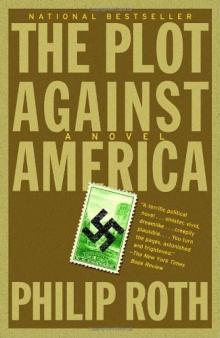
Amazon.com Review"What if" scenarios are often suspect. They are sometimes thinly veiled tales of the gospel according to the author, taking on the claustrophobic air of a personal fantasia that can't be shared. Such is not the case with Philip Roth's tour de force, The Plot Against America. It is a credible, fully-realized picture of what could happen anywhere, at any time, if the right people and circumstances come together.The Plot Against America explores a wholly imagined thesis and sees it through to the end: Charles A. Lindbergh defeats FDR for the Presidency in 1940. Lindbergh, the "Lone Eagle," captured the country's imagination by his solo Atlantic crossing in 1927 in the monoplane, Spirit of St. Louis, then had the country's sympathy upon the kidnapping and murder of his young son. He was a true American hero: brave, modest, handsome, a patriot. According to some reliable sources, he was also a rabid isolationist, Nazi sympathizer, and a crypto-fascist. It is these latter attributes of Lindbergh that inform the novel.The story is framed in Roth's own family history: the family flat in Weequahic, the neighbors, his parents, Bess and Herman, his brother, Sandy and seven-year-old Philip. Jewishness is always the scrim through which Roth examines American contemporary culture. His detractors say that he sees persecution everywhere, that he is vigilant in "Keeping faith with the certainty of Jewish travail"; his less severe critics might cavil about his portrayal of Jewish mothers and his sexual obsession, but generally give him good marks, and his fans read every word he writes and heap honors upon him. This novel will engage and satisfy every camp."Fear presides over these memories, a perpetual fear. Of course, no childhood is without its terrors, yet I wonder if I would have been a less frightened boy if Lindbergh hadn't been president or if I hadn't been the offspring of Jews." This is the opening paragraph of the book, which sets the stage and tone for all that follows. Fear is palpable throughout; fear of things both real and imagined. A central event of the novel is the relocation effort made through the Office of American Absorption, a government program whereby Jews would be placed, family by family, across the nation, thereby breaking up their neighborhoods--ghettos--and removing them from each other and from any kind of ethnic solidarity. The impact this edict has on Philip and all around him is horrific and life-changing. Throughout the novel, Roth interweaves historical names such as Walter Winchell, who tries to run against Lindbergh. The twist at the end is more than surprising--it is positively ingenious.Roth has written a magnificent novel, arguably his best work in a long time. It is tempting to equate his scenario with current events, but resist, resist. Of course it is a cautionary tale, but, beyond that, it is a contribution to American letters by a man working at the top of his powers. --Valerie RyanFrom Publishers WeeklyDuring his long career, Roth has shown himself a master at creating fictional doppelgängers. In this stunning novel, he creates a mesmerizing alternate world as well, in which Charles A. Lindbergh defeats FDR in the 1940 presidential election, and Philip, his parents and his brother weather the storm in Newark, N.J. Incorporating Lindbergh's actual radio address in which he accused the British and the Jews of trying to force America into a foreign war, Roth builds an eerily logical narrative that shows how isolationists in and out of government, emboldened by Lindbergh's blatant anti-Semitism (he invites von Ribbentrop to the White House, etc.), enact new laws and create an atmosphere of religious hatred that culminates in nationwide pogroms.Historical figures such as Walter Winchell, Fiorello La Guardia and Henry Ford inhabit this chillingly plausible fiction, which is as suspenseful as the best thrillers and illustrates how easily people can be persuaded by self-interest to abandon morality. The novel is, in addition, a moving family drama, in which Philip's fiercely ethical father, Herman, finds himself unable to protect his loved ones, and a family schism develops between those who understand the eventual outcome of Lindbergh's policies and those who are co-opted into abetting their own potential destruction. Many episodes are touching and hilarious: young Philip experiences the usual fears and misapprehensions of a pre-adolescent; locks himself into a neighbor's bathroom; gets into dangerous mischief with a friend; watches his cousin masturbating with no comprehension of the act. In the balance of personal, domestic and national events, the novel is one of Roth's most deft creations, and if the lollapalooza of an ending is bizarre with its revisionist theory about the motives behind Lindbergh's anti-Semitism, it's the subtext about what can happen when government limits religious liberties in the name of the national interest that gives the novel moral authority. Roth's writing has never been so direct and accessible while retaining its stylistic precision and acute insights into human foibles and follies. Copyright © Reed Business Information, a division of Reed Elsevier Inc. All rights reserved.
Read online
  • 3 320
The Facts

The Facts

Philip Roth

Fiction

The Facts is the unconventional autobiography of a writer who has reshaped our idea of fiction—a work of compelling candor and inventiveness, instructive particularly in its revelation of the interplay between life and art. Philip Roth concentrates on five episodes from his life: his secure city childhood in the thirties and forties; his education in American life at a conventional college; his passionate entanglement, as an ambitious young man, with the angriest person he ever met (the "girl of my dreams" Roth calls her); his clash, as a fledgling writer, with a Jewish establishment outraged by Goodbye, Columbus; and his discovery, in the excesses of the sixties, of an unmined side to his talent that led him to write Portnoy's Complaint. The book concludes surprisingly—in true Rothian fashion—with a sustained assault by the novelist against his proficiencies as an autobiographer.
Read online
  • 700
Patrimony

Patrimony

Philip Roth

Fiction

Winner of the National Book Critics Circle Award, "a tough-minded, beautifully written memoir.... It smacks of honesty and truthfulness on every page" (San Francisco Chronicle).Patrimony, a true story, touches the emotions as strongly as anything Philip Roth has ever written. Roth watches as his eighty-six-year-old father—famous for his vigor, charm, and his repertoire of Newark recollections—battles with the brain tumor that will kill him. The son, full of love, anxiety, and dread, accompanies his father through each fearful stage of his final ordeal, and, as he does so, discloses the survivalist tenacity that has distinguished his father's long, stubborn engagement with life.
Read online
  • 379
Deception

Deception

Philip Roth

Fiction

"With the lover everyday life recedes," Roth writes—and exhibiting all his skill as a brilliant observer of human passion, he presents in Deception the tightly enclosed world of adulterous intimacy with a directness that has no equal in American fiction. At the center of Deception are two adulterers in their hiding place. He is a middle-aged American writer named Philip, living in London, and she is an articulate, intelligent, well-educated Englishwoman compromised by a humiliating marriage to which, in her thirties, she is already nervously half-resigned. The book's action consists of conversation—mainly the lovers talking to each other before and after making love. That dialogue—sharp, rich, playful, inquiring, "moving," as Hermione Lee writes, "on a scale of pain from furious bafflement to stoic gaiety"—is nearly all there is to this book, and all there needs to be.
Read online
  • 225
The Breast

The Breast

Philip Roth

Fiction

David Kepesh wakes up one morning in the hospital, mysteriously altered. Through an endocrinopathic catastrophe of unprecedented proportions, he has been transformed into a 155-pound human female breast. Railing at the incomprehensible, he uses his intelligence to deny and resist the thing he has become. Ultimately, he must accept his fate. Philip Roths The Breast is a funny, fantastical story and a bizarre yet daring exploration of sex and subjectivity.
Read online
  • 70
Nemesis n-4

Nemesis n-4

Philip Roth

Fiction

With Nemesis Roth leaps back again, to Newark in 1944, in the summer, polio season — but this year, the worst outbreak of polio in a lifetime, and long before there was even a glimpse of a vaccine. The fact of the eradication of polio, an affliction unknown in the lifetime of most Americans now, only makes Roth's recreation of the disease all but horror-movie immediate: unstoppable, unpredictable, unknowable, evading diagnosis until it is too late, with cases spreading through a neighborhood by the hour and children dead overnight or consigned to an iron lung for the rest of their lives (and what is an iron lung, any reader might have to ask, only to find out, and then be horrified at how polio could redefine everyday life?).
Read online
  • 69
Our Gang

Our Gang

Philip Roth

Fiction

A ferocious political satire in the great tradition, Our Gang is Philip Roth's brilliantly indignant response to the phenomenon of Richard M. Nixon.In the character of Trick E. Dixon, Roth shows us a man who outdoes the severest cynic, a peace-loving Quaker and believer in the sanctity of human life who doesn't have a problem with killing unarmed women and children in self-defense. A master politician with an honest sneer, he finds himself battling the Boy Scouts, declaring war on Pro-Pornography Denmark, all the time trusting in the basic indifference of the voting public.From the Trade Paperback edition.
Read online
  • 68
Letting Go

Letting Go

Philip Roth

Fiction

Letting Go is Roth's first full-length novel, published just after Goodbye, Columbus, when he was twenty-nine. Set in 1950s Chicago, New York, and Iowa city, Letting Go presents as brilliant a fictional portrait as we have of a mid-century America defined by social and ethical constraints and by moral compulsions conspicuously different from those of today.Newly discharged from the Korean War army, reeling from his mother's recent death, freed from old attachments and hungrily seeking others, Gabe Wallach is drawn to Paul Herz, a fellow graduate student in literature, and to Libby, Paul's moody, intense wife. Gabe's desire to be connected to the ordered "world of feeling" that he finds in books is first tested vicariously by the anarchy of the Herzes' struggles with responsible adulthood and then by his own eager love affairs. Driven by the desire to live seriously and act generously, Gabe meets an impassable test in the person of Martha Reganhart,...
Read online
  • 65
The Professor of Desire

The Professor of Desire

Philip Roth

Fiction

As a student in college, David Kepesh styles himself “a rake among scholars, a scholar among rakes.” Little does he realize how prophetic this motto will be—or how damning. For as Philip Roth follows Kepesh from the domesticity of childhood into the vast wilderness of erotic possibility, from a ménage a trois in London to the throes of loneliness in New York, he creates a supremely intelligent, affecting, and often hilarious novel about the dilemma of pleasure: where we seek it; why we flee it; and how we struggle to make a truce between dignity and desire. “Philip Roth is a great historian of modern eroticism. . . . [He] speaks of a sexuality that questions itself; it is still hedonism, but it is problematic, wounded, ironic hedonism. His is the uncommon union of confession and irony. Infinitely vulnerable in his sincerity and infinitely elusive in his irony.” —Milan Kundera“A thoughtful . . . elegant novel. . . . A fine display of literary skills.” —The New York Times Book ReviewA brilliant, lustful man is overloaded with fantasies.
Read online
  • 64
Exit Ghost

Exit Ghost

Philip Roth

Fiction

Like Rip Van Winkle returning to his hometown to find that all has changed, Nathan Zuckerman comes back to New York, the city he left eleven years before. Alone on his New England mountain, Zuckerman has been nothing but a writer: no voices, no media, no terrorist threats, no women, no news, no tasks other than his work and the enduring of old age.Walking the streets like a revenant, he quickly makes three connections that explode his carefully protected solitude. One is with a young couple with whom, in a rash moment, he offers to swap homes. They will flee post-9/11 Manhattan for his country refuge, and he will return to city life. But from the time he meets them, Zuckerman also wants to swap his solitude for the erotic challenge of the young woman, Jamie, whose allure draws him back to all that he thought he had left behind: intimacy, the vibrant play of heart and body.The second connection is with a figure from Zuckerman's youth, Amy Bellette, companion and muse to...
Read online
  • 57
The Dying Animal

The Dying Animal

Philip Roth

Fiction

David Kepesh is white-haired and over sixty, an eminent TV culture critic and star lecturer at a New York college, when he meets Consuela Castillo, a decorous, well-mannered student of twenty-four, the daughter of wealthy Cuban exiles, who promptly puts his life into erotic disorder.Since the sexual revolution of the 1960s, when he left his wife and child, Kepesh has experimented with living what he calls an "emancipated manhood," beyond the reach of family or a mate. Over the years he has refined that exuberant decade of protest and license into an orderly life in which he is both unimpeded in the world of eros and studiously devoted to his aesthetic pursuits. But the youth and beauty of Consuela, "a masterpiece of volupté" undo him completely, and a maddening sexual possessiveness transports him to the depths of deforming jealousy. The carefree erotic adventure evolves, over eight years, into a story of grim loss.What is astonishing is how much of America's...
Read online
  • 57
183